

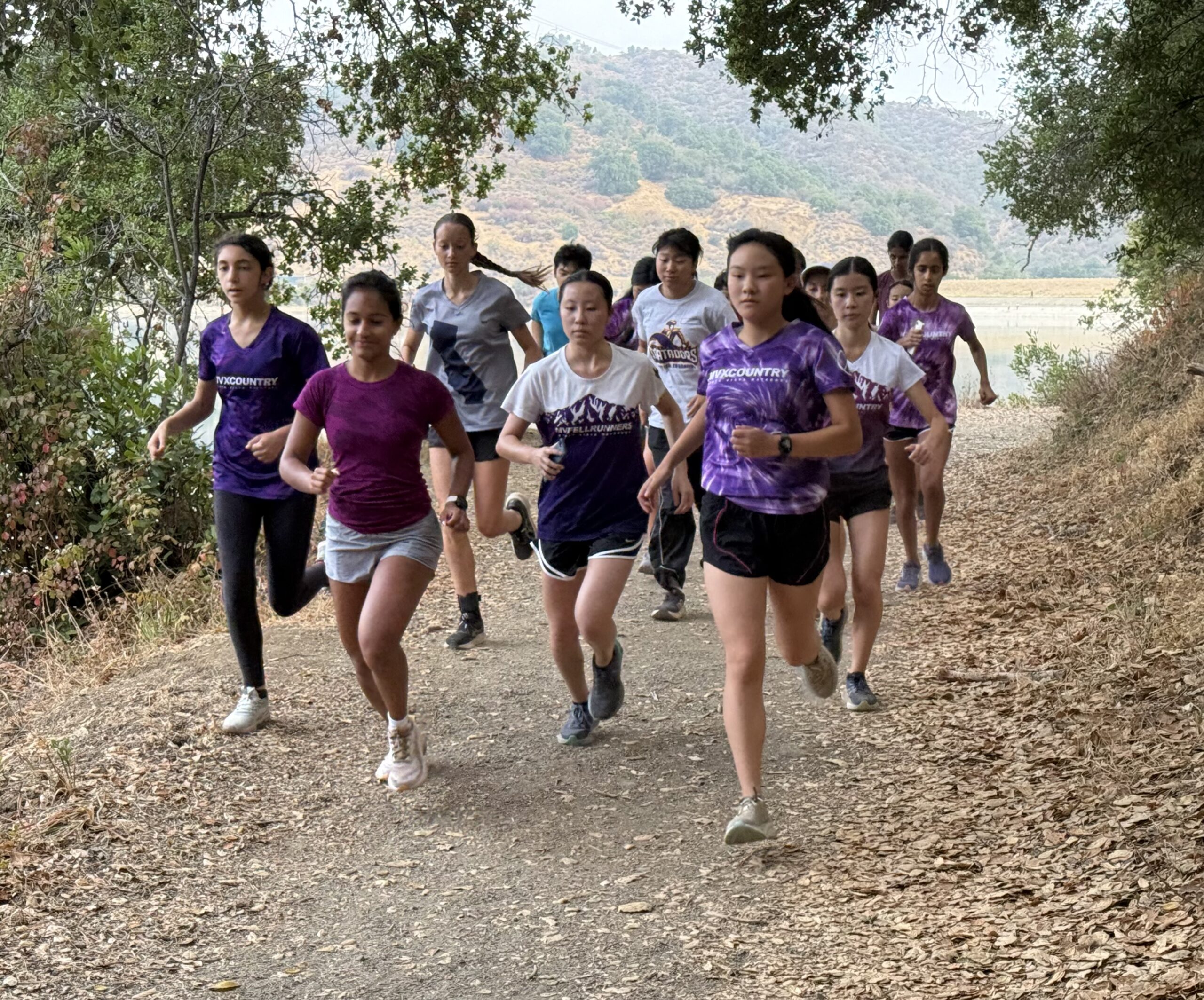
 The cool, cloudy weather on the morning of Saturday, August 23 was a relief after a week of scorching afternoon workouts. There were 29 cross country runners ready to run—and what a day we had.
The workout was Matador Ks; 1000 m intervals run at lactate threshold pace, with short recoveries. As we run and our muscles work, lactic acid is produced as a byproduct. Lactate threshold pace is the fastest speed a runner can sustain while clearing lactic acid as fast as it is produced. Training at lactate threshold pace helps improve the body’s ability to process lactate efficiently. Over time, this will increase endurance and improve race performance by delaying the onset of fatigue, allowing distance runners to run faster for longer periods. Research has shown that a runner’s lactic threshold is arguably the best single indicator of race performance.
The run was fantastic, with a lot of wonderful workouts recorded by our athletes. And notably, we had fun! I don’t think many of our athletes felt this was a grind—most (all?) of the athletes enjoyed the work, and it went by a lot faster than the new runners expected. When we got back to school, one of the freshmen looked up at me and said, “Wait, coach, my watch is telling me I just ran 9 miles—is that right?” Yes, it was!
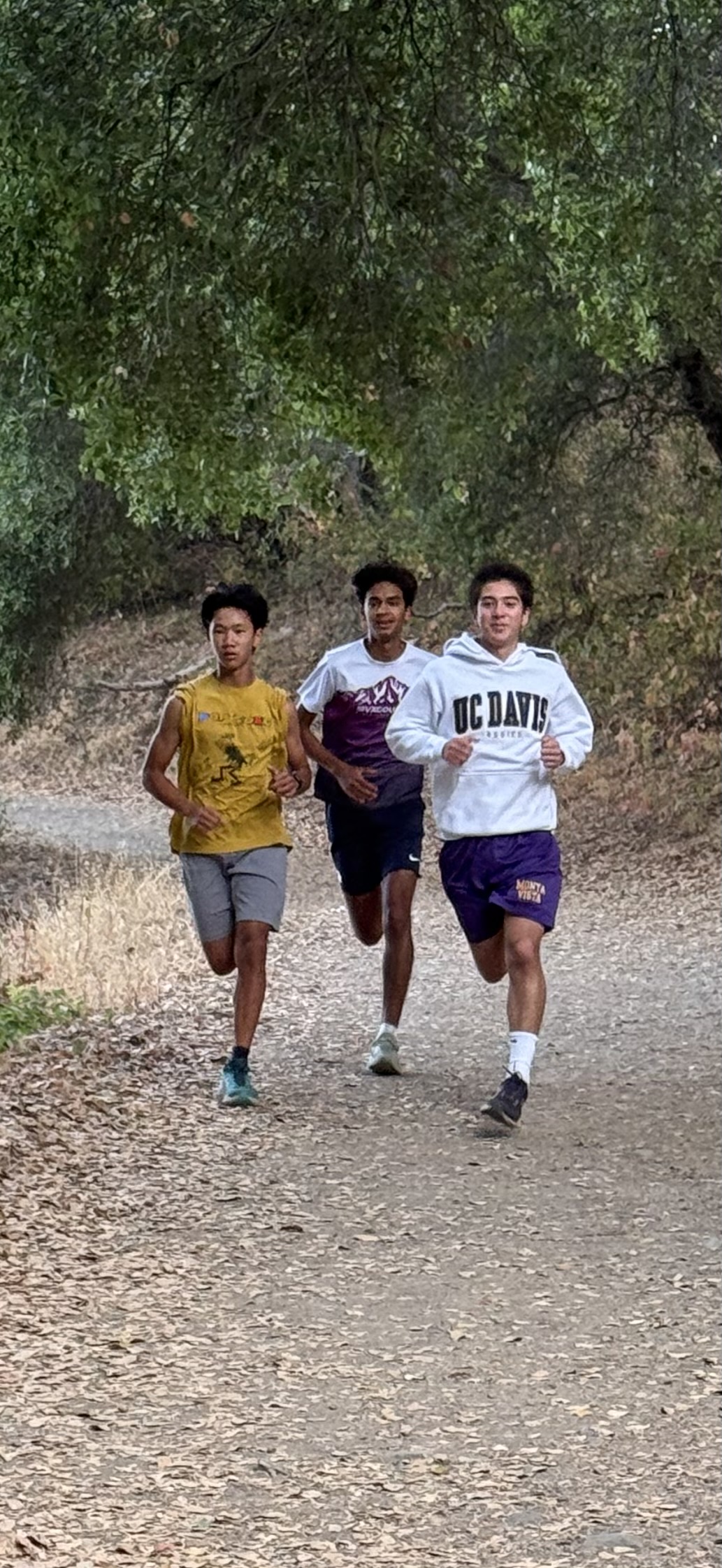
A few notes.
- Keeping a running log helps us see our progress improvement. Every one of the runners who ran this workout last year showed improvement—faster pace, more reps, or both. Medha averaged 11 seconds faster per rep than in 2024, Sam, Darren, and Vikram knocked off 16 to 32 seconds while adding a rep, Riu and Tarun were 21 seconds per rep quicker while adding two reps, and Myra averaged a full minute faster per interval while going an additional K. All these athletes worked for these gains. Records help us see how far we have come.
- We can overestimate the difficulty of a task—so just get up and do it. My guess is that in advance, both the runners who did get up and run this workout (and the ones that did not) were thinking that the workout seemed challenging and would be very uncomfortable, and getting up to be at school ready to run was not going to feel so good. Yet when I said “OK, first group on the line,” a dozen kids pushed themselves up without any more urging and within 30 seconds everyone was on the course. Within five minutes after the last rep, all the kids and one of the coaches were down by the reservoir laughing and having a spirited rock-skipping contest. No one was devastated! It was fine. (Psychologists call our predictions of our future feelings, for example how we will feel during and after a workout or a race, affective forecasting. There is a tendency to predict that our feelings about an event will be more extreme than what actually occurs, for instance that getting up early will make us feel awfully sad, that the workout will be more painful than it actually will be, and that the discomfort from our effort will last longer than it actually will last; this tendency to anticipate extremes is called impact bias. The point is—we can talk ourselves out of a workout or a class or a task because we anticipate it will make us feel worse than it really will.) (For an exhaustive read on the subject, see Affective Forecasting by Timothy Wilson and Daniel Gilbert, published in 2003 in the journal Advances in Experimental Social Psychology. The paper was based on funding from an NIH RO1 grant.)
- Being part of a good team does matter. One of my favorite psychological studies looked at how people evaluate challenges. In the experiment, participants were asked to estimate the steepness of a hill using a haptic paddle board. When a friend stood beside them, the test subjects consistently judged the hill to be less steep than when they stood alone. This experiment validates a feeling I have had my entire life: with the support of friends or teammates, challenges will feel more manageable. Being part of a close, supportive team truly changes how we perceive and obstacles, and how vigorously we go after hard things.
I think about the freshman who could not believe she just ran a 9-mile workout. I think that if in advance she had been asked to predict how she would feel if she was going to get up at 7 AM and run that distance and perform that workout, she would have predicted that it would be incredibly hard and she would feel incredibly bad afterwards. Instead, she thought her records must be wrong—she didn’t say that the morning was easy, but it certainly was not soul-destroying.
Being part of a team can get us places we did not imagine. We can all set all sorts of personal records this season, in races and workouts and just running. First time we run to the top of Up and Over without stopping. First time to run 30 miles in a week. First time to clock 9 miles in a day.
I hope all of you feel that by the end of this season!
And a final note…for what it is worth, I was so happy all this morning! Watching all you runners throw yourselves into a workout like this is wonderful. I get a lot of joy seeing you push yourselves and support each other. And it was moving to watch Coach Triya out there pacing some of you. In 2019, I was out on that trail pacing Coach Triya through Matador Ks and Miles (until she dropped me). Watching her pace you is emotional–really, really great.
