

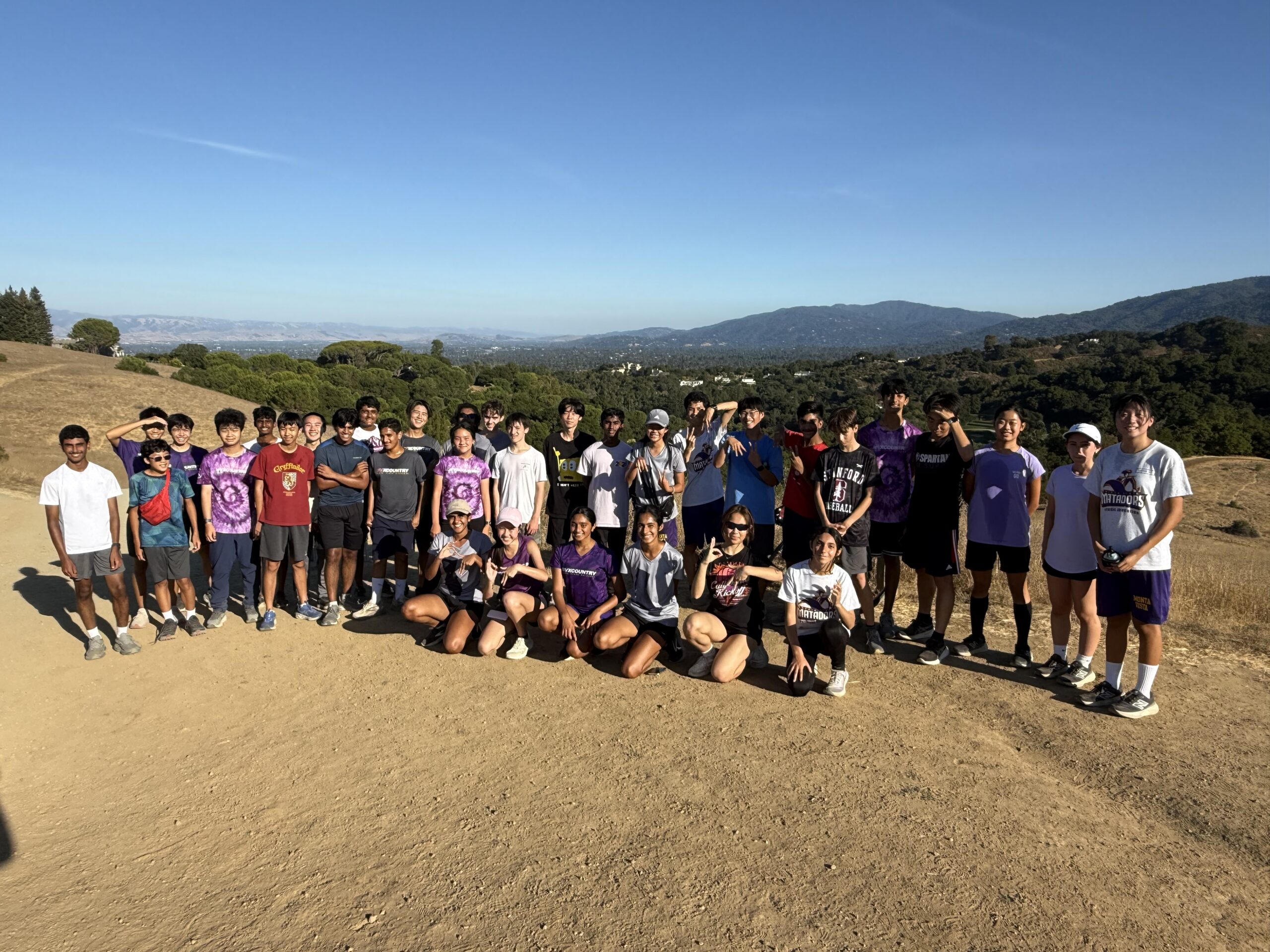
Thank you to everyone who came to the Winter Training presentation on Monday, November 24. I’m so gratified that we have so many runners eager to continue training! I mentioned that Coach Triya and I ran into a MVXC athlete who was already out on the track on Sunday, too…with this kind of enthusiasm, this off-season will be successful—and we will have a fun and successful track season, too. Many of you will experience a lot of improvement, I believe it!
Attached is the presentation from our discussion, and the worksheet I passed out. You can use that format or start a word or spreadsheet doc of your own—there is no one “right” way to do your planning. If have questions, feel free to send me a Discord message or an email (coachflatow@gmail.com). You can also send me your plan for comments if you would like—planning is optional, not a required assignment.
There were a few new distance-curious athletes who joined the meeting—Sarah brought a friend :). If you want to direct the new runners to me, I’m happy to come up with a start-up plan. Medha, Sam, and others could be good resources to help get new runners started. Help any new people get started and enjoy it!
Below are some suggestions for hill, stride, and UA/Steady State workouts. If you are trying to think of what to do, pick something from one of these menus, or maybe this will inspire you to think of your own. I’ll post things now and then also.
If you try one of these suggestions from any of the menus, would you please drop me a Discord and let me know what you thought?—hard, easy, confusing, straightforward, I felt like <???>, I enjoyed this, I’ll tell my friends, here is where I did this, I’ll never do THAT again…I’d like to hear what you think so I can keep improving this list.
And have some adventures! You might have time to organize a road trip to someplace else. Maybe recreate the beach run we did in Wilder Ranch, but in the winter. I have ideas. Go nuts, exploring on foot is fun!
Good luck, happy running, and go get after it!
Hill Repeat Menu
- Short and Fast Hill Reps:
- Grade: Find a fairly steep hill, like Linda Vista or Matt’s (6-10°). You can do this in the middle of your run in Fremont Older or anyplace you find a nice hill.
- Reps: 6-12 reps with 8-15 seconds duration. Jog into the start of each hill, building to your 8-12 second burst.
- Effort: 95-100% but should feel smooth, not straining. We want good form–imagine you are posing for a Nike ad!
- Recovery: Walk or jog back, full recovery, breath back to normal before the next rep.
- Keys: We want to roll into the effort, not have a standing start, to teach a smooth build up to max speed and also reduce the injury risk of a hard, static start. Focus on trying to “snap” off the ground, knees pulling up, not straining—each rep should feel like a drill more than like conditioning.
- Increasing-Length Hill Sprints:
- Reps: 4 x 6 sec, full recovery; then 4 x 10 sec, full recovery; 2 x 15 sec, full recovery.
- Discussion: The slightly lengthening reps change the recruitment patterns for muscles and systems, and capping at 15 seconds means this will not be a a fatiguing workout.
- Wind-Up then Uphill Sprint:
- Where: You know that rolling, up and down section after the water tank at the top of Horse? Pick one of those dips.
- What: Run downhill at an easy to moderate pace, and at the bottom of the hill, transition to a 6 – 10 second uphill sprint.
- Reps: 4 – 6
- Recovery: Walk back, take time for a full recovery until your breath is normal again. After you are done, continue with your run.
- Discussion: You will create some fast turnover before you hit the uphill. This should promote power, and help you get quicker rebound/shorter ground contact as you climb. This is kind of a distance runner’s version of a sprinter’s depth jump.
- Split Reps:
- What: each rep is [5 seconds hard + 5 seconds easy + 5 seconds hard]
- Reps: 4-6
- Recovery: Walk back, full recovery.
- Discussion: Power levels are still high but this adds some variation to the stresses.
- Bounding:
- Find a steeper than typical hill.
- Focus on powerful bounds up the hill (length rather than speed).
- Reps: 4 to 8, 8 to 10 seconds each.
- Recovery: Full recovery.
- Discussion: Builds elastic force, coordination, and hip extension and hip strength.
- More discussion: You probably have no clue what I am talking about! So here is a video on bounding. But better than that…if you want to try this, why not arrange for Coach Smith to teach you how to bound on the football field, and then take that knowledge to the hills?!? I am guessing he would be happy to teach you!
- Pyramid:
- 6 sec, 8 sec, 10 sec, 8 sec, 6 sec. {or 8-10-12-10-8}
- Discussion: Change it up a bit if you are getting bored of hill reps!
- Medium Hill Repeats:
- Look for a shallower hill (4-6°) such as Matt’s or Linda Vista.
- 6-8 reps x 30-50 seconds. You can do all the same, or a pyramid, or a ladder down. You can vary your repeats, or do this same (at the beginning of my marathon cycles, I had a hill in Vasona Park I loved, and I would run 6 to 8 x 30-35 second repeats, once a week for four to six weeks, to build strength and to dial in my running form.
- Effort: Comfortably hard (like a tempo effort not sprinting).
- Jog recovery.
- Discussion: Be aware of form, don’t hunch or overstride. Don’t dig down deep; the last reps should feel tougher but still controlled, not a max effort. This is a workout, but we don’t want to go too hard.

Stride Menu
- The Basic:
- There is nothing wrong with 6 x 100 m strides!
- Accelerate the first third, max but good form the middle third, gently decelerate the last third.
- Full recovery between reps.
- In-and-Outs:
- Run these on the track at the end of your run.
- Stride the straightaways; you can roll into each stride by gradually accelerating as you come off the curve, finding your max when you are getting to the middle of the straight, then decelerate gradually as you come to the next curve.
- Recover with a slow shag around the curve, and repeat.
- 6-8 reps (1200 to 1600 total meters).
- This can feel like a nice way to end a run, and you are not standing around waiting to recover.
- Coach has a clear memory of rolling up to our track while my teammates and I were running in July, and we found these two brothers who ran track for South Pasadena high school and were visiting their uncle and aunt, and we got to talking as we ran in-and-outs around our hope track…it was really nice.
- Pyramid:
- 80-100-120-120-100-80.
- Working on our kick:
- Roll into a 150 m stride that finishes at the finish line on the track.
- 250 m jog recovery and roll into the next one.
- 3 reps are plenty (you can go to 4 after you have done 3 at least twice recently).
- These strides can feel like money after a long run.
- 30/30s:
- I’m including these in strides because they fulfill a similar niche in our running.
- Run 30 seconds at a hard, not quite 5 km race pace (go by feel, each rep should feel a touch faster than a comfortably hard threshold pace). Then jog 30 seconds for recovery and repeat 4 to 8 times (4 to 8 minutes total).
- I find this to be nice at the end of a long or maintenance run, when I just want to hustle back to the finish. This workout is going to stimulate both your kick, your speed, and your VO2max—and it makes a mile go by fast.
Steady State / Upper Aerobic Menu
- Continuous Run:
- At its simplest, a Steady State run is simply continuous running at about 30 seconds faster per mile than your typical conversational pace; you can still talk to your running partner, but not as easily. Maintain that pace for 20 to 40 minutes; for a high school runner, 20-30 minutes is reasonable. The Palm Tempo route is an easy place to start…but you don’t need to turn this into a tempo run, you can back off a bit from the pace you ran in season. For many of us, the three-mile tempo route will land us between 20 and 30 minutes, if you want to add some more, simply continue on the track and add a mile for a total of four miles. At the end of this you should not feel wrecked; if you finish and you need to bend over with your hands on your knees that is harder than target. If I were there and asked you to run another mile at the same pace, the answer should be “yep, I can do that!” This is a workout, but we want you to be able to bounce back and run the next day without any lingering fatigue.
- Other routes for a continuous Steady State/Upper Aerobic run:
- Here is a four-mile tempo route from the base of the dam at Stevens Canyon, back to McClellan, then hop on the bike path to Stevens Creek Boulevard, to Orange and Byrne and back to school.
- If you want to travel, the Los Gatos Creek Trail has a lot of routes, starting either from Los Gatos or Campbell. Ask Coach Triya or Coach Flatow for suggestions.
- There are routes in Rancho, such as in Rogue Valley, that can be fun for these runs.
- Intervals:
- You can also run a Steady State run in intervals. Intervals can be mentally easier than a continuous run, especially for new runners. A key is to make the recovery very short—this is a mental break, not a physical break. We don’t want to fully recover, the break is more of a mental reset than anything.
- A classic for MVXC is to go run Matador Miles—but remember, this is meant to be slightly easier than the way you probably ran these in-season, but maybe because you run at a conservative pace you can tag on one more rep.
- Another idea is to run the Palm three mile route, take a 1 minute break, and tack on a mile on the track—not continuous but adds volume.
- Fartlek:
- Fartlek is a Swedish word for “speed play,” and this can be a fun way to get some variety in your steady state running.
- What we would do is to run four to five surges lasting three to five minutes, at a comfortably hard pace, about 30 seconds per mile faster than our conversational pace. This should feel comfortably hard, and you should still be able to talk to your friends, but not as easily as easily as convo pace. In between each surge, drop back to our conversational pace for one to two minutes. This will give us 16 to 35 minutes of Upper Aerobic training, and we break it up to add interest.